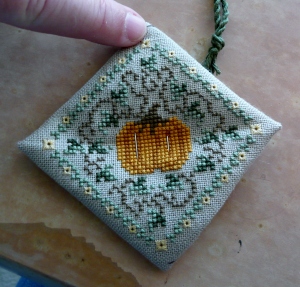
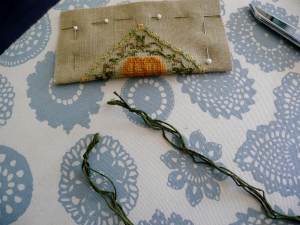
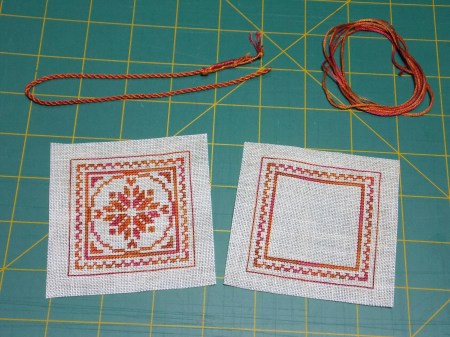
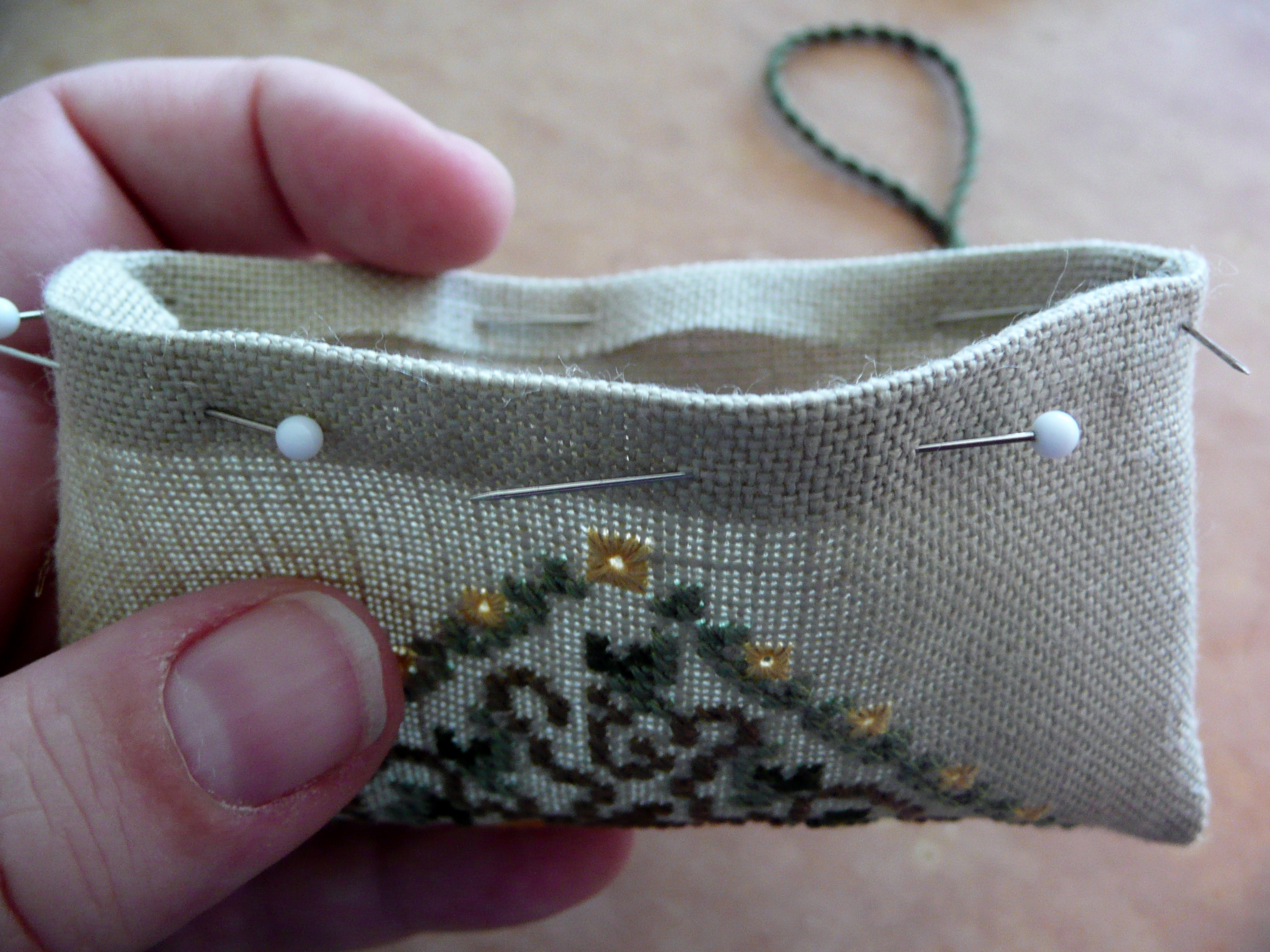
Christmas Ornament tutorial

November 1, 2009

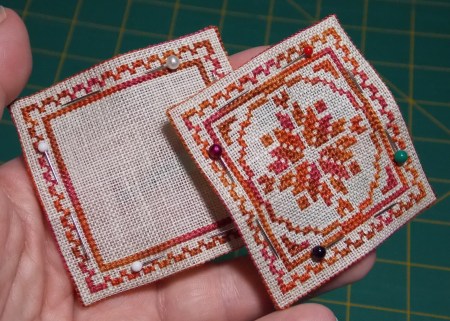
I personally don’t think the Just Cross Stitch ornie magazine is very clear with their finishing instructions for ‘newbies’ so I thought I’d make one up myself to help people out that haven’t done this type of fnishing before – and show just how simple it is :)

This will also hopefully kickstart me into preparing a few more tutorials in the upcoming months … just need to get some stitching finished so I have some smaller things to finish! LOL.  Anyway, without further ado, here’s the latest tutorial – hope it will be useful to someone :)

j0439073

CHRISTMAS ORNAMENT TUTORIAL

(the way Prairie Schooler finishes them)

Ornament-Tutorial-1

Materials needed:

  • Stitched ornie
  • Felt in coordinating colour
  • Cardboard (I use mattboard)
  • Batting
  • Ribbon for hanger
  • Glue
  • Thread for lacing (I use crochet cotton or pearl cotton)

j0439073

The following piccies are all clickable for closer views …

1. Firstly measure your stitched ornie for the size that you want the cardboard to be.

Ornament-Tutorial-2

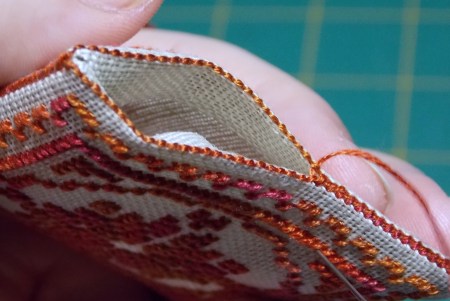
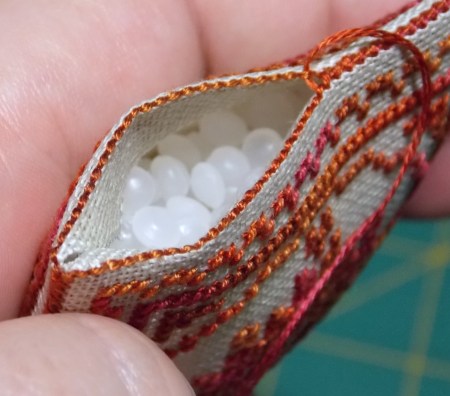
2. Next, cut out your cardboard/mattboard to the desired size. Add glue to one side of the cardboard, and place glue-side down on your batting. Even though I don’t show it in the photos, I actually smooth down the glue with a little offcut of mattboard so that the glue covers the cardboard evenly – that way you don’t feel ugly bumps on the front when it dries.

Ornament-Tutorial-3 Ornament-Tutorial-4

3. Once the glue has dried, cut around the cardboard shape and cut off the excess batting (my mattboard is black on one side, it just happened to be the piece that our local framers gave me).

Ornament-Tutorial-5 Ornament-Tutorial-6

4. Now it’s time to attach the stitched piece to the padded mattboard.

Ornament-Tutorial-7

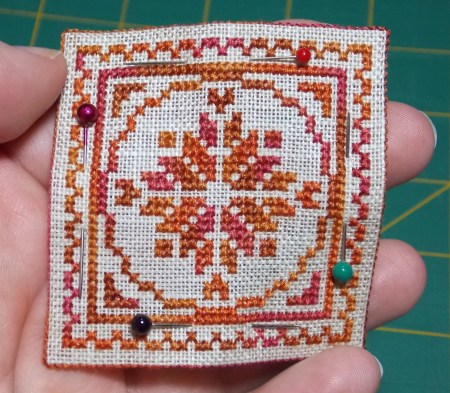
Turn the stitching over so the good side is facing down – place the padded mattboard padded-side down on top of the stitching.

Ornament-Tutorial-8 Ornament-Tutorial-9

5. My instructions for the next part are in relation to lacing the ornie together – I’ve found that this gives a much cleaner finish on the front of the ornie, and in particular in the corners. If you don’t want to lace, you can just use glue to stick the sides down in the same way – you’ll just have to be careful that the glue doesn’t dry before you have the stitched piece nicely centred on the front.

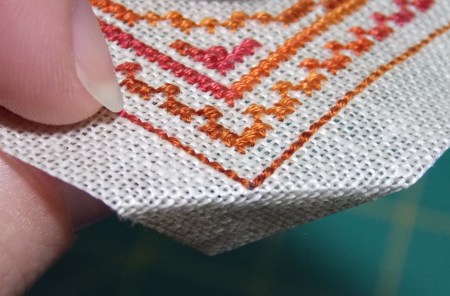
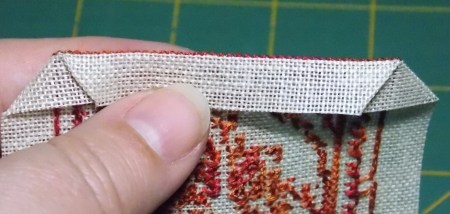
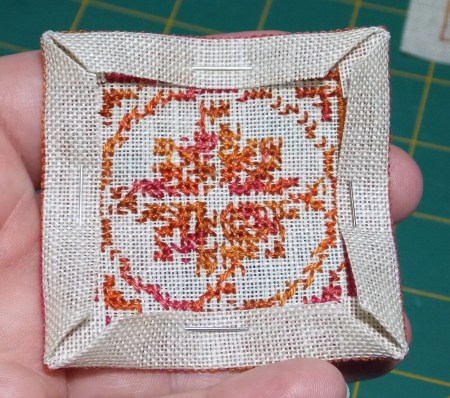
6. First of all I start by folding over the corners, then the sides. This ornie was stitched by my Mum on Aida, which is quite stiff and stays put, which is great :)

Ornament-Tutorial-10 Ornament-Tutorial-11

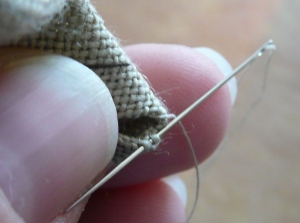
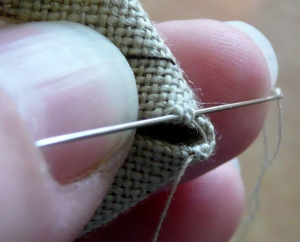
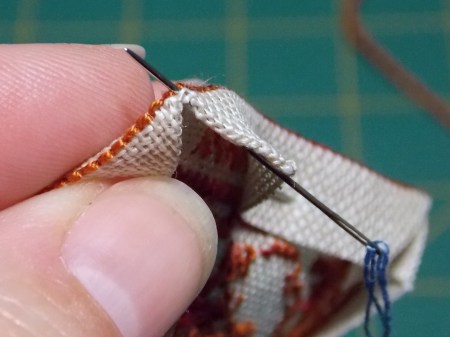
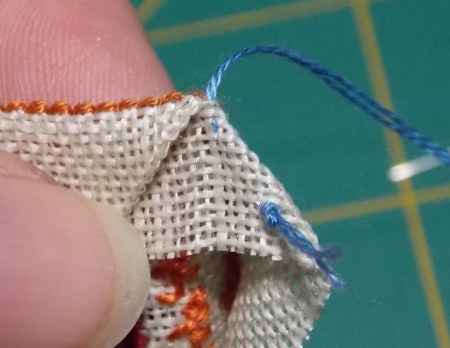
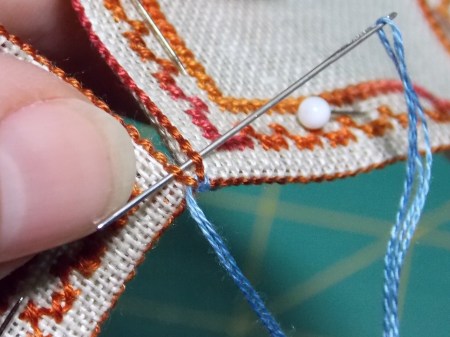
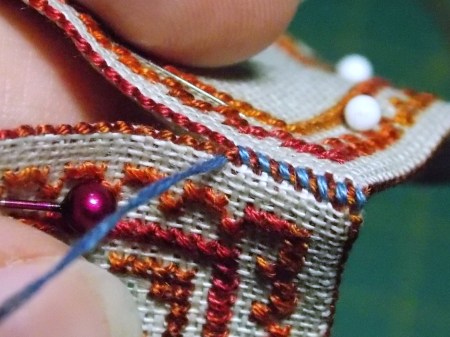
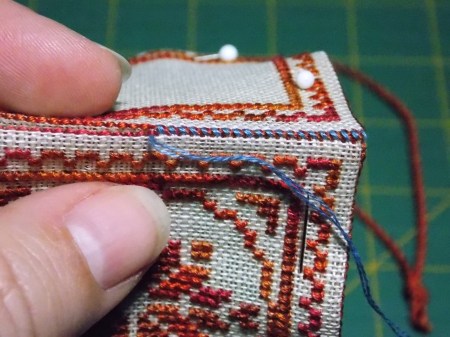
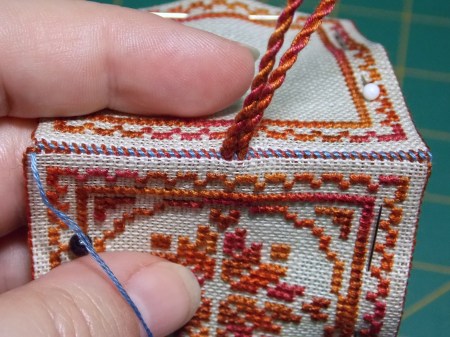
7. Next I start lacing – I usually start with a couple of little anchor stitches at the start, but here I used a waste-away knot first (this will be cut off later) – then you just work from one side of the ornie to the other, as you can see from the series of photos below.

Ornament-Tutorial-12 Ornament-Tutorial-13

8. At this point turn the stitched piece over and check that the stitching is sitting nicely centred over the mattboard. If it’s not centred perfectly, just give it a little jiggle around until it is nicely centred.

Ornament-Tutorial-14

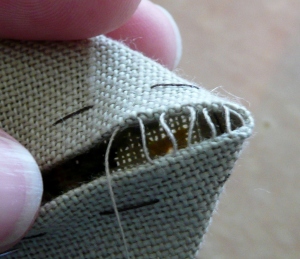
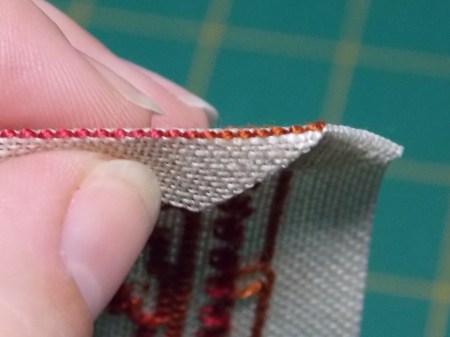
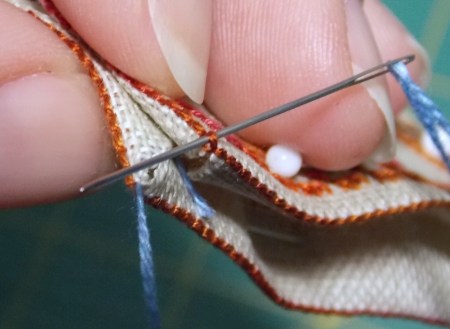
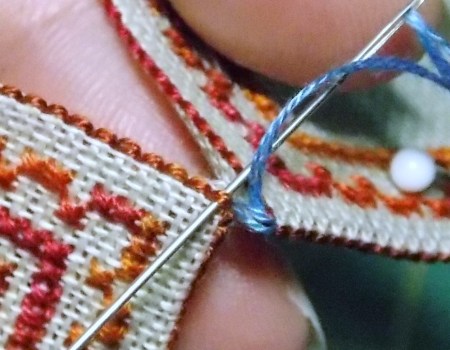
9. Turn the ornie back over again, and continue to lace the remaining two sides. Now I usually stitch up the mitred corners, as this really tidies p the corners and gives nice clean points.

Ornament-Tutorial-15 Ornament-Tutorial-16

10. The finished version should look something like this if you’ve laced it according to my version.

Ornament-Tutorial-17 Ornament-Tutorial-18

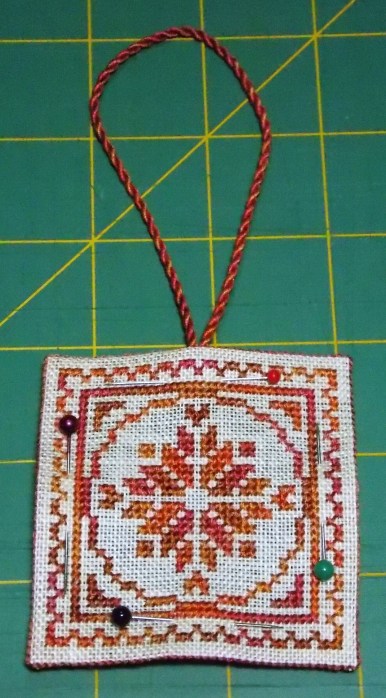
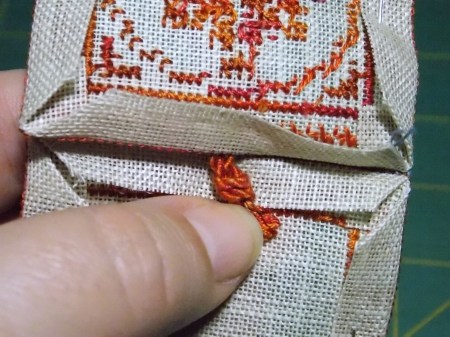
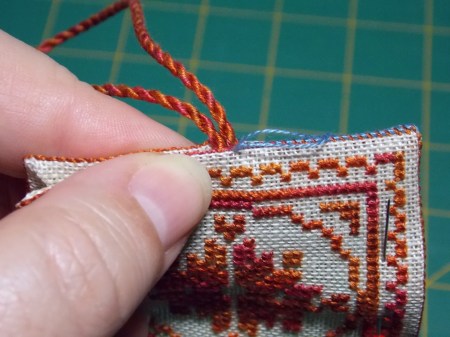
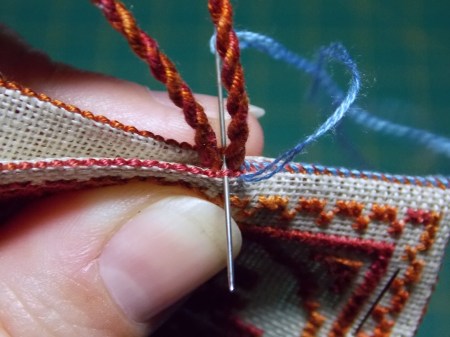
11. You now have the choice of adding your ribbon hanger now, or at the end. I always used to add my hanger at the end, but decided to try it this way for the tutorial, and have added the ribbon prior to adding the felt backing.

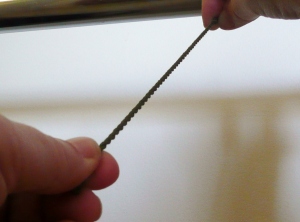
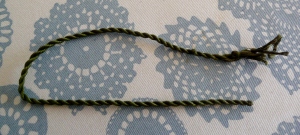
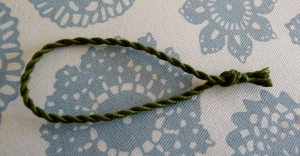
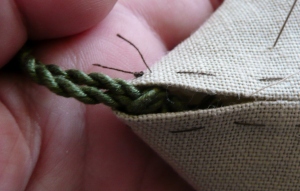
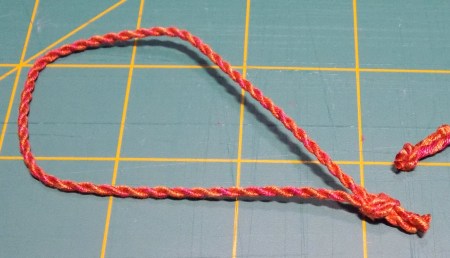
Cut a piece of ribbon to your preferred length – I ‘twist’ my ribbon to give it a nice loop, if you just fold it in half the ribbon doesn’t sit quite as nicely. Hopefully that makes sense, and you can see what I mean from the photos! Attach the ribbon with a couple of little stitches to attach it to the fabric – I prefer to stitch it rather than just gluing to ensure the ribbon hanger doesn’t fall off in a hurry.

Ornament-Tutorial-19 Ornament-Tutorial-20

12. Next, turn your ornie over and add glue to the back – I usually use Tacky Glue and once again I use a little offcut of mattboard to spread the glue out all over the backing, but this isn’t essential. I figure this will help to keep the glue stuck down for longer than just having a little bit on the edges :)

Ornament-Tutorial-21 Ornament-Tutorial-22

13. Now place your glued ornie down on the felt backing and ensure the felt is pressed down nice and evenly onto the glue. Then, using pinking shears, cut around the ornie shape – don’t forget to hold your ribbon hanger out of the way so it’s not accidentally lopped off!

Ornament-Tutorial-23 Ornament-Tutorial-24

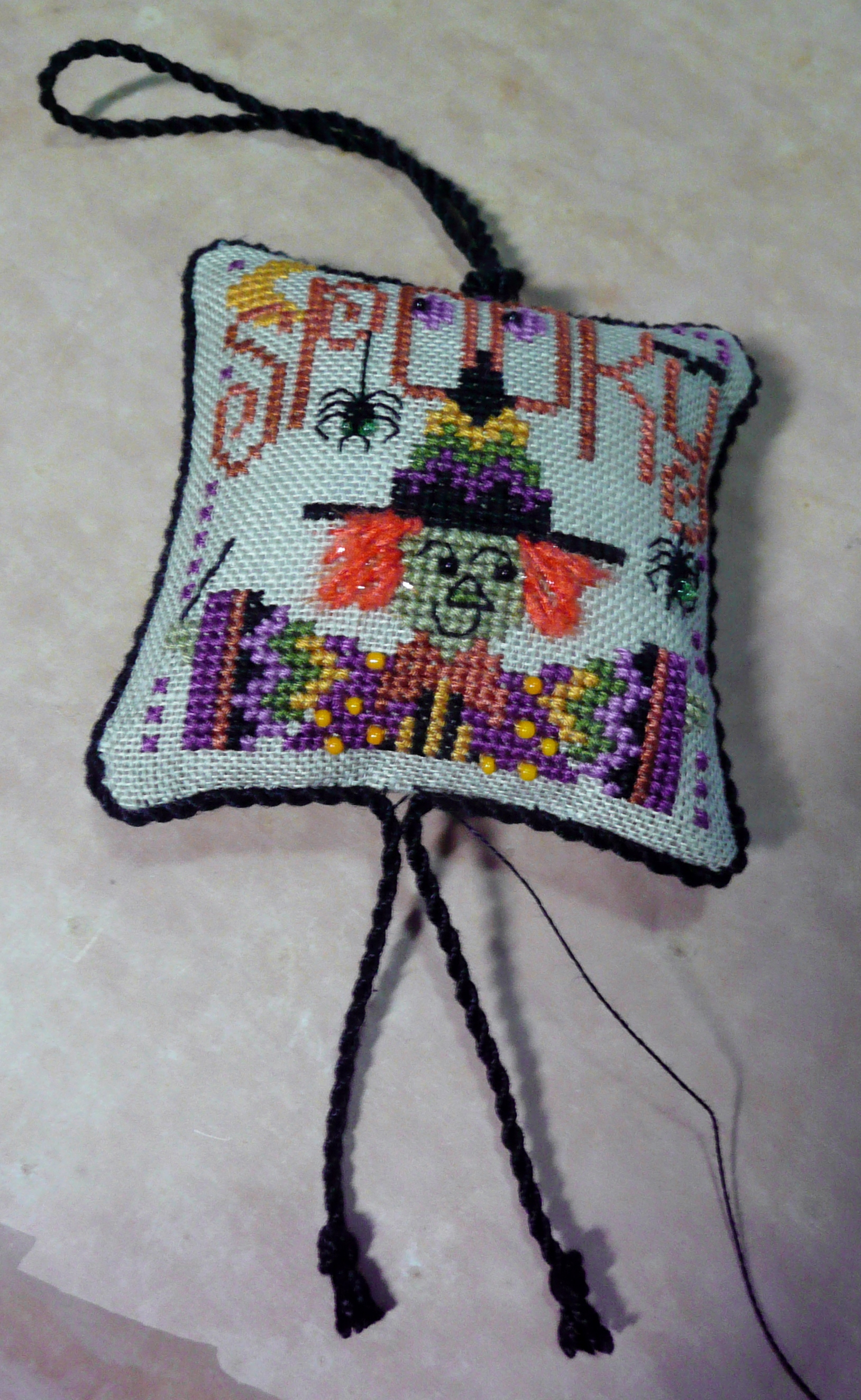
14. If you prefer to add your ribbon hanger at the end, this is an example of one of my older finished ornies that I completed this way :)

Ornament-Tutorial-27

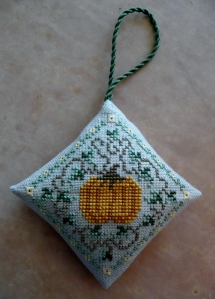
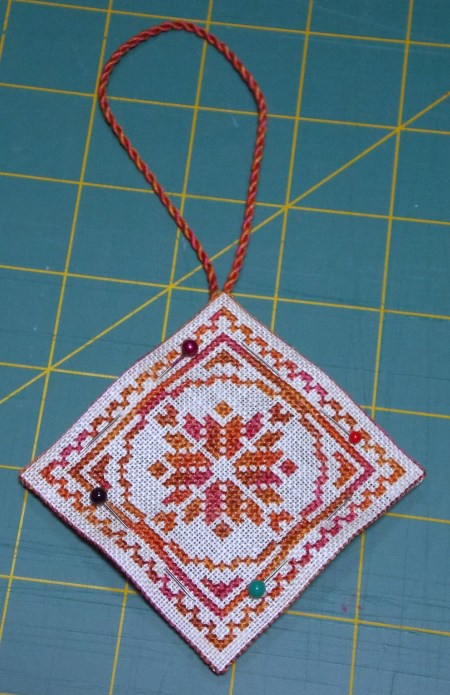
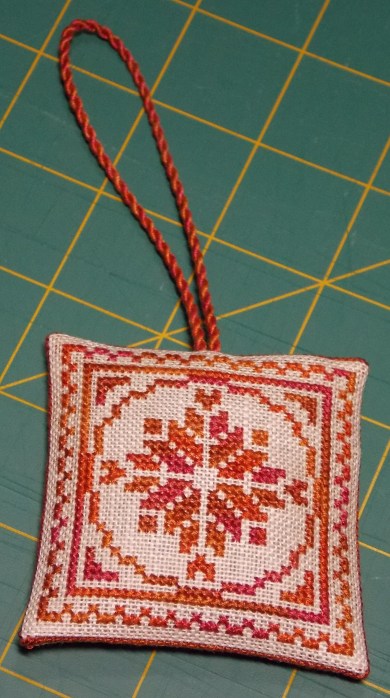
15. And you now have a beautifully finished ornie – all you have to do is to hang it up on your (or a loved one’s) tree! :D

Ornament-Tutorial-25

Ornament-Tutorial-26

j0439073

I hope that’s easy enough to follow – if you have any questions, don’t hesitate to scream out and I’ll try to answer them.

j0439073


Our new home is ready for occupation!! Focus on Finishing is moving to Blogger…

September 14, 2008

Hi everyone – it’s been a while since I announced the idea of moving the Focus on Finishing blog to the more popular Blogger platform. That idea has finally come to fruition, and the new site is ready to have all the posts copied over. Here is a preview of the new look:

screenshot of FOF blogger blog

Anyway, I hope you will enjoy the new home … I, for one, am quite thrilled with the clean, fresh new look of the blog (it’s been fun spending a few hours tweaking the HTML codes!). The new link is:

FOCUS ON FINISHING
(http://focusonfinishing.blogspot.com)

It would be wonderful if you would be willing to post photos of any items you have finished using our tutor’s classes, or any other finishing methods you would like to share. If there is enough interest, I would also be happy to reopen the idea of having a weekend set aside each month to focus on finishing our projects languishing in the finishing pile.

Please update your bookmarks so you don’t miss any new posts – these existing pages, however, will still be kept open as I will continue to maintain the classes schedule etc via WordPress as I find that easier.

Unfortunately each WP post has to be copied over individually into Blogger, so it is going to be a long and arduous task to copy over the old posts and classes, but they will gradually be added over time.

Thanks for your continued support of this blog :)

Kind regards,


A Needle Case for your needle packets

August 17, 2008

Who doesn’t need a special something to hold their needle packets?  Since I use a lot of different types of needles in my embroidery, I like to keep them in their packets.  I’ve made a needle case to organize my packets that will help me find the needles I need easily.

To make the needle case, you’ll need:

  • your finished embroidery, 12 inches long by 6 inches wide
  • light weight cotton for the lining, 27 inches long by 6 inches wide
  • #12 perle cotton
  • a small length of ribbon
  • 2 pieces of skirtex or light weight cardboard, 5-1/2 inches by 5 inches each
  • a hot iron

I stitched a stumpwork design for my needle case but the finishing instructions will work for surface and counted embroidery, including cross stitch and crazy quilting. 

Click here for the needle case instructions (pdf)

I hope you will enjoy making your own needle case and will find this tutorial useful.  If you have any questions or need clarification on any of the steps, leave a comment here and I will try to answer in this section for everyone’s benefit.


Stawberry fob finishing

July 13, 2008

Summer Quaker Strawberry for Amy in SC
Hello all,

I’m running a bit late this month but have finally cobbled together some photos and text for Strawberry fob finishing.

First gather your equipment…

first gather your equipment
For this project you will need:

  • Stitched project – some suggestions: Prairie Schooler chart 100 – American Strawberries & chart 101- Prairie Strawberries (used for this tutorial), Anita’s little Stitches designs, Blackbird Designs – there is a strawberry fob in the Secret Garden pattern (OOP) from the Loose Feathers series of 2006 and a Blackbird Designs also designed a fabulous quaker strawberry for the 2006 Annual Just Cross Stitch Christmas Ornaments issue (I’m sure this one is still available).
  • Interfacing
  • Ribbon, felt
  • Stuffing
  • Scissors, needle, thread, pins.
  • Iron

And you can see in this photo, I also made sure I had a cup of tea to work with.
Iron on the interfacing on the reverse side of your stitching
Take your stitched piece and iron a piece of interfacing to the reverse of the stitching.
pin the template on and cut around
Make a semi-circle template, pin to the stitching and cut around. You can see I have mucked up centering this up with the “quiltish” strawberry above – this is not really a problem for this finishing technique.
fold and finger press the straight seam
Next, finger-press a small seam along the straight edge. Make this seam as close to the stitching as possible.
use a ladder stitch to join the straight seams
Fold the semi-circle to form a cone (see above). Stitch the straight seams together. I like to use a ladder stitch to do this, but you can use a sewing machine if you wish (I find it is easier to do this by hand).
you might be able to make out the ladder stitch from this photo
I kinda hoped you’d be able to see the ladder stitch in this photo. If you pull it nice and tight it disappears into the seam. I’m pretty pleased with the join for this strawberry.
run a gathering stitch around the edge of the cone shape
If you used the ladder stitch to join the seam, secure the thread and then run a gathering stitch around the top of the cone around 1/2 an inch from the top.
add stuffing and pull the running stitch gather.
Draw the gathers together a little and stuff your strawberry – I’ve used hobbyfill.
gathering the top of the strawberry
Draw the gathers tighter and run a few stitches across the “opening” and pull these tight to secure your thread. You can insert a hanger at this point if you wish, stitch through it as you secure your thread.
Top of the strawberry with felt cap in place, tacked down.
For my first strawberry, I’ve attached a felt cap. I cut the felt out using the template in the pattern (Prairie Schooler pattern 101: Prairie Strawberries) and tacked it to the strawberry.
sewind down the felt cap
Next, I stitched around the felt using a buttonhole stitch – making sure I caught the linen beneath. Then I attached the second felt star (template from the prairie schooler pattern) using buttonhole stitch.
felt wool cap all complete
Attach a hanger to the top. I made a loop of ribbon and secured with tiny tacking stitches and slipped a bead over the ribbon to hide the stitches.

Another pretty way to finish the strawberry is to tie ribbons around the hanger – I learned this technique from Janie Hubble from The Cat’s Whiskers Design Studio at a class last year.

attaching hanger and first ribbon bow for a ribbon capped strawberry
Here’s the other design I stitched from Prairie Strawberries by Prairie Schooler. You can see in the photo I have gathered the top and inserted the hanger. I’ve cut a length of ribbon and tied it in a bow around the hanger. Just keep tying bows around the hanger – pushing them down towards the strawberry. Have them facing in different directions.
ribbon cap all done
When you are satisfied with the ribbons, trim the ends and you are done.
The completed strawberries out in my little garden
Here are the two finished strawberries. I love them! – So cute!
I hope you will enjoy making your own strawberries too and will find this tutorial useful.
Cathy.


Treat Bag Tutorial

May 16, 2008

Here is the wonderful Treat Bag Tutorial put together by Celeste – I think you’ll all agree that it’s a real stunner, and the instructions put together are superb! 

Due to the difficulties of learning to use the WordPress platform, and to allow us to get this published on time, this tutorial has been prepared in a .pdf format.  Hopefully I can work out myself how to get this file attached here so you can download it! ;)

As always, please feel free to leave any questions and/or feedback in the comments section of this post.

Enjoy! :)

Treat Bag Tutorial instructions are here (please click for .pdf).


Blog announcement

May 13, 2008

This is just a quick post to let everyone know that I have decided to move this blog over to the Blogger platform shortly.  While my own personal preference is for WordPress, most tutors are more comfortable with the Blogger platform for posting, as well as most users so it is the logical step to allow further interaction and ease of posting for the majority of bloggers.

It will take me a while to fix up the new home (it’s a bit of a ‘doer-upper’ at the moment), and transfer all the previous posts over, but once that is done I will make a final announcement here along with links to the ‘new’ site.  Unfortunately Blogger don’t have “page tabs”, which I particularly love, so I intend to keep the WP pages active in this blog with links to those pages from the new Blogger blog.  As I am the only person to update these pages, this will be much simpler and less time consuming for me.

Thanks in advance for your patience during this transition phase.  I look forward to breathing some new life into the blog and making a few more regular posts soon!

Kind regards,
Anne S


Tuck Pillow Tutorial

May 3, 2008

Welcome to our tuck pillow tutorial. This tutorial will be for a 7″ flat door hanger tuck pillow but you can make yours any size you like. Smaller tuck pillows are good for Christmas ornaments. To recap, following is a list of what you need to make the pillow.

  • your stitched piece
  • main fabric for pillow – a fat quarter will be plenty
  • neutral fabric for back of opening – a scrap piece the size of your pillow. I use calico/quilters muslin/homespun or whatever it’s called in your country.
  • fusible fleece wadding – the width of your pillow. I use fusible fleece on my pillows as I prefer the finish it gives to the back of the pillow. You can, of course, use any batting you prefer. Something not too thick is best.
  • cord for hanging
  • sewing machine
  • thread


Cut 1 piece of main fabric 7½” by 7½” for the back

Cut 1 piece of neutral fabric the same size

Cut 1 piece of fusible fleece the same size

Cut 4 strips of main fabric 7½” by 2½”


Fuse the fleece onto the wrong side of the main fabric piece – this piece will form the back of the pillow. I always use a pressing cloth for this step. If you are using a non-fusible batting, pin the batting to the wrong side of the main fabric piece & sew using a ¼” seam. Now treat this piece as one.


Fold the 4 strips of main fabric lengthwise, wrong sides together. Press.


Place 2 of the strips onto the top and bottom of the right side of the back pillow piece, raw edges together (the folded edge will be in the middle) & pin.


Place the other 2 strips on the sides of the right side of the main piece & pin. Do not sew yet!


At this time, you will add your hanger. First of all you need to ascertain which edge is the top of your pillow (this is only crucial if your pillow is rectangular or the fabric strips/main fabric have a one way design). Pin your cording piece between the strips and the main fabric piece making sure the cording loop is in the middle of the pillow, NOT poking out through the seam – the ends WILL be poking out of the seam and will be trimmed later (see pic for clarification).


Now sew all these pieces together using a ¼” seam. To ensure the cording stays put, you can backstitch over this part or sew that part of the seam again to reinforce it.


Place the neutral fabric and main pillow piece right sides together with the strips sandwiched in the middle and pin.


Now sew these seams using a ¼” seam, leaving an opening for turning. Trim the seams, corners & cording.


Now turn the pillow right side out and VOILA, your very own tuck pillow!


You may, if you wish, whip stitch the opening (which will now be situated inside the pillow) closed. However, I usually just leave it as no one can see it. Give the pillow a good press to make it nice and flat.


Now you can add your finished cross-stitch piece which, hopefully, will fit into the opening. You can secure it with buttons at the corners or just leave it. I find that the stitched piece doesn’t move much unless the cat gets at it & gives it a bat!


Calculating other sizes of pillows


To calculate a different pillow size, all you need to do is measure your finished cross stitch piece and add 1½” to all sides. That measurement will be your main fabric and batting size and strip length. The width of the strips will be 2½”.

Keep in mind that the larger you make your pillow, the wider the strips should be. This, in turn, will also affect the size of the opening so double check that your stitched piece will fit!


Tuck Pillow Tutorial

April 26, 2008

Next weekend will be our tutorial on making tuck pillows.  Tuck pillows are very versatile. They can be stuffed like a pillow or left flat. They can be used for Christmas ornaments and hung on a tree, or used as a door hanger. This tuck pillow tutorial will be for a flat door hanger about 7″ square. Instructions to calculate other sizes will be included in the tutorial.

You will need:

  • Your stitched piece (duh!)
  • Fabric for your pillow – a fat quarter should be plenty unless you’re making something bigger than 9″
  • Scrap of neutral fabric for the back of the opening – calico, muslin, homespun
  • Fusible fleece wadding – same size as your pillow. You can use a non-fusible batting if you prefer. Something not too thick is best.
  • Cord for hanging
  • Sewing Machine
  • Thread/scissors etc

I’ll be back next weekend with the tutorial!


Book Cover Tutorial

March 21, 2008

Hello everyone! I hope you’ve got the items ready. Here’s a recap:

img_0416.jpg

You will need the following items:

1. A stitched piece, size ½” to 1” allowance around the front of your book or a part of it if you prefer.
2. Some coordinating fabric for the side, back and inside flap of the book.
3. Muslin or calico for the backing
4. Book to cover ;)
5. Matching sewing threads
6. Ribbons to tie (optional)

Instructions for a particular step will be at the bottom of the picture (if any).

Step 1

img_0419.jpg

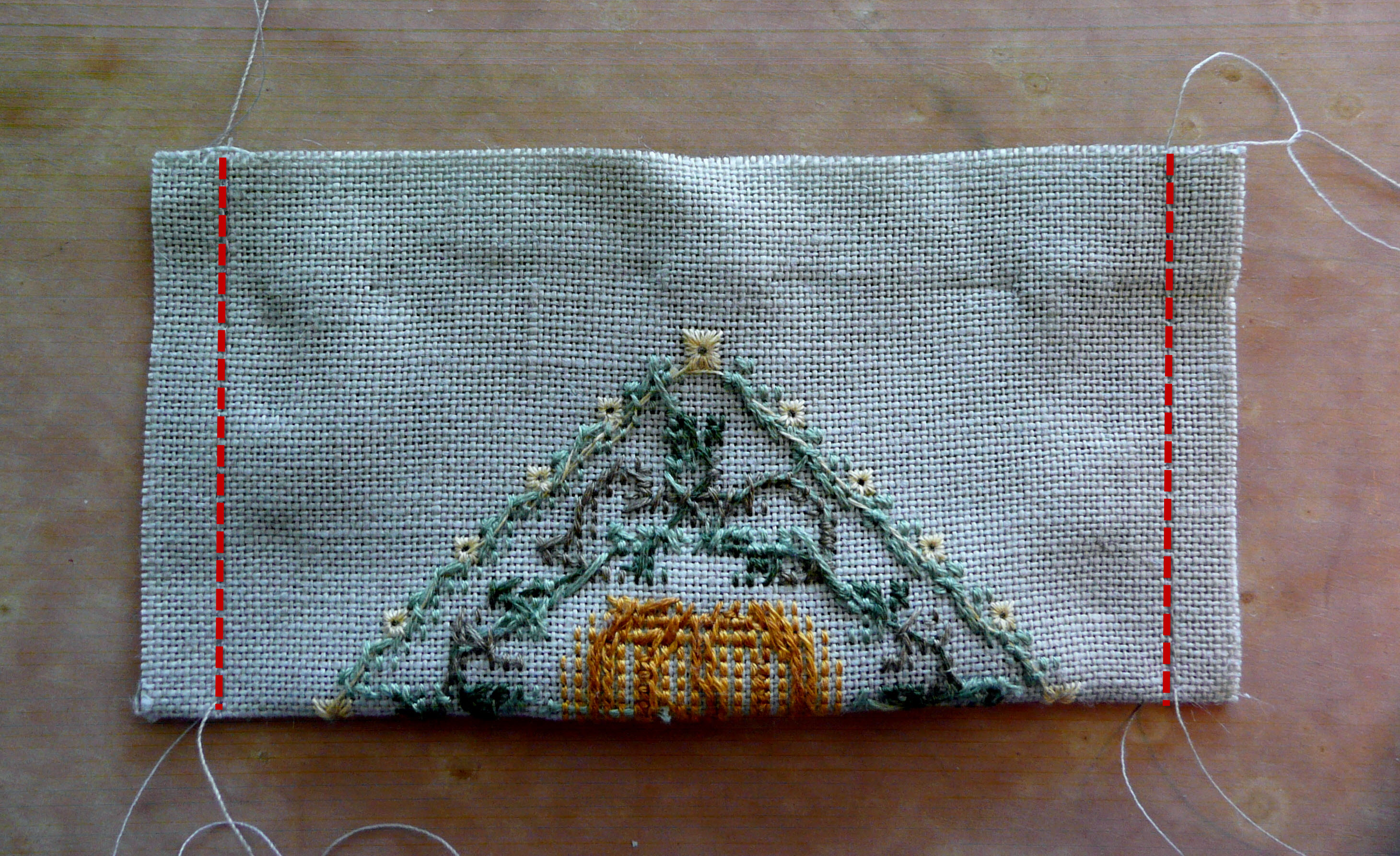
Determine the size of your stitched piece that will cover the book and pull one thread from each side of the stitched piece. This will help to ensure the lines that you machine sew are straight. The stitched piece can cover the front of the book or partially or cover the front and back of the book. It’s up to you. In my example the stitched piece covers the front of the book partially.

Step 2

img_0423.jpg

Measure and cut the length and width that you will need to cut from the co-coordinating fabric. Wrap from the left edge (where one thread was pulled) to the back of the book. Add necessary seam allowances on all sides. Machine sew the coordinating fabric and the stitched piece. Iron open the seam.

Step 3

img_0424.jpg

Cut 2 additional pieces of the coordinating fabric about ½ the width of your book, add necessary seam allowances. Machine sew one edge of both the flaps after measuring and ironing a double seam.

Step 4

Cut the backing fabric the same size as the cover piece.

Step 5

img_0428.jpg

Sewing them all together. Lay the cover piece right sides up. Place the flaps, wrong side up on the both sides of the cover piece with the stitched edge towards the middle. Pin accordingly.

Step 6

img_0429.jpg

Place the backing fabric wrong side up and again pin accordingly.

Step 7

img_0432a.jpg

Machine sew from the top of the back portion of covered piece, about and inch before the flap starts. Backstitch a couple of stitches to fasten the beginning. Proceed to sew up all 4 sides but leave about a 3” opening for turning. Again backstitch when you end.

Step 8

img_0436.jpg

Trim all sides to 1/4″ and cut the corners to reduce bulk.

Step 9

img_0434.jpg

Turn the cover inside out. It’ll be a mess but nothing that cannot be ironed out :)

Step 10

img_0445.jpg

Stitch by hand to close the opening with matching thread.

Step 11

img_0437.jpg

Give it a good ironing. Insert the book covers into the flap and there you have it your very own book cover! :)

img_0439.jpg

img_0442.jpg

Optional embellishments:

  • Add a piece each of rick-rack, lace or ribbon on the sewn edge of the book flaps
  • Add two long strips each of ribbon at mid point of the right and left edge of the book for a ribbon tie closure
  • Add a small loop of ribbon/cord on the front side edge of the book and a larger loop at the back. Slip the larger loop into the smaller loop creating a closure that you can wrap around your wrist
  • Add a ribbon/cord for bookmark where the opening was and stitch by hand or securely by machine.
  • And anything else you can think of!

Samples of book covers:

If you have any questions please feel free to comment here and I will answer them in the comment section itself so as to centralise the Q&A for everyone’s benefit.

Thank you all for joining our tutorial this weekend. Pictures are always welcomed :)


Meari’s Needlebook Tutorial

March 12, 2008

Making a needlebook really isn’t all that difficult.  Here are my step-by-step instructions for making a needlebook:

Materials Needed:
• Whatever you’ll be using for your stitched piece. You choose the design, fabric, embellishments, etc. Stitched pieces should be approximately 3-4″ square. If you want the back cover stitched, you’ll have to take that into consideration also.  Size is approximate. You can make it larger, smaller, rectangle, square, etc.  It’s up to you!

• Coordinating cotton fabric of your choice. I’ve found that the quilt fats (18×22″ fabric) are perfect. Or look in the odds and ends bin at the fabric stores to see if there’s anything that might work. If you want pockets on the inside of your needlebook, you’ll need two pieces of fabric. This is the fabric that will go on the inside of your needlebook, so the size depends on the size of your stitched piece, and whether or not you stitched a back cover.

• Matching 1/4″ ribbon. Shouldn’t need much more than 14″.

• Flat quilt batting – again, the amount depends on size of needlebook. 1/4 yd. should do it.

• Piece of coordinating felt. 5×8″ piece should work.

• Coordinating thread to sew it all together.

• Scissors to cut fabric, batting, and felt.

• Sewing Machine. You can sew it together by hand, but a machine makes it go faster and easier.

• Iron

Step One:
Decide on what to stitch for your needlebook cover.


Step Two:
Choose coordinating fabrics for the back cover and inside cover. Cut the back cover the same size as the front cover. Cut the inside cover the same height as the front/back cover, and twice as wide minus 1/2″. Cut the quilt batting the same size as the inside cover (Quilt batting not shown in pic). Press all the pieces with an iron, except for batting.


Step Three:
Take front cover and back cover and place right sides together. Stitch right hand side with 1/4″ seam allowance.


Step 4:
Press seam open.


Step Five:

Here’s where the fun part starts! Assemble your pieces. Front/Back Cover, Inside Cover, Batting, Ribbon.

Note: If you want to put pockets inside your needlebook, you will have to cut a piece of fabric the same width as the Inside Cover, and 2/3 the height PLUS 1/2″. Fold 1/2″ to the wrong side of the fabric, along the LONG edge. Press flat with iron. On the same long side of fabric, stitch a seam 1/4″ from folded over edge. Place Pocket with right side down on table. Place Inside Cover on top with right side down, matching bottom edges. Make 1/4″ seam on each short edge. The drawing shows what it should look like with the right side facing you. (There are no pics because I didn’t put pockets in this one).

Take your Inside Cover and place it right side down on table. Place batting on top. Set aside.


Place your Front/Back Cover right side up (stitching facing you). Cut two pieces of ribbon 6-8″ each. Place ribbon on right and left side of cover. You may want to (temporarily) pin the ribbon in place. There are no pics of this part because I forgot (!!!) to put my ribbon on and had to improvise. However, I have relied on my artistic talents to draw a diagram.


Place the Inside Cover/Batting on top of the Front/Back Cover and Ribbon. You may want to pin all three layers together to make sewing it together easier.


You will want to leave a 3″ opening at the bottom of your needlebook so that you can turn it inside out. Notice where I started my seam?


Stitch 1/4″ seam all the way around the edge of the needlebook, stopping about 3″ from where you started. Notice where I stopped?


Once the sewing is done, you can remove the pins. This is what your needlebook should look like once you’ve sewed the outside seams.


Trim the batting close to the seam. Be careful not to cut the fabric. Once you’ve trimmed the batting, cut the corners at an angle. This is what it should look like.


Step Six:
Carefully turn your project inside out. Your Front/Back Cover, Inside Cover, and Ribbons should be on the outside. The batting should be on the inside. To help get your corners “pointy”, use a slim object to push them out. I used a wood skewer. You can also use a knitting needle, crochet hook, pen with a cap on. Be careful not to poke the object through the fabric.


Using the iron, press the front and back of your needlebook. You will have to tuck in the fabric where the opening is at the bottom of your needlebook.


Step Seven:
Take needle and thread to sew the opening closed. Press both sides of your needlebook again.


Step Eight:
Cut felt 1/4″ smaller than the inside of your needlebook. One piece of felt will make 2 pages. If you wish to have 4 pages, cut 2 pieces of felt. I personally wouldn’t do more than 4 pages as it would make the needlebook pretty bulky. Optional: I used pinking shears to cut the edges of the felt.


Place felt in the center of the needlebook. Use pins to hold it in place.


Place needlebook on sewing machine with felt side down and Front/Back Cover facing up. Stitch a line where the front and back covers are seamed together.


This is what it should look like when the felt page(s) are stitched in.


I hand-sewed on the gold cording to match the closure. Tie the ribbon and viola, you have a finished needlebook!

Here are other needlebooks I’ve made:
Je Brode/I Embroider
Friendship Grows

Here are needlebooks created from my tutorial: More Needlebooks

If you have any questions, feel free to email me at mearitaira@yahoo.com.